
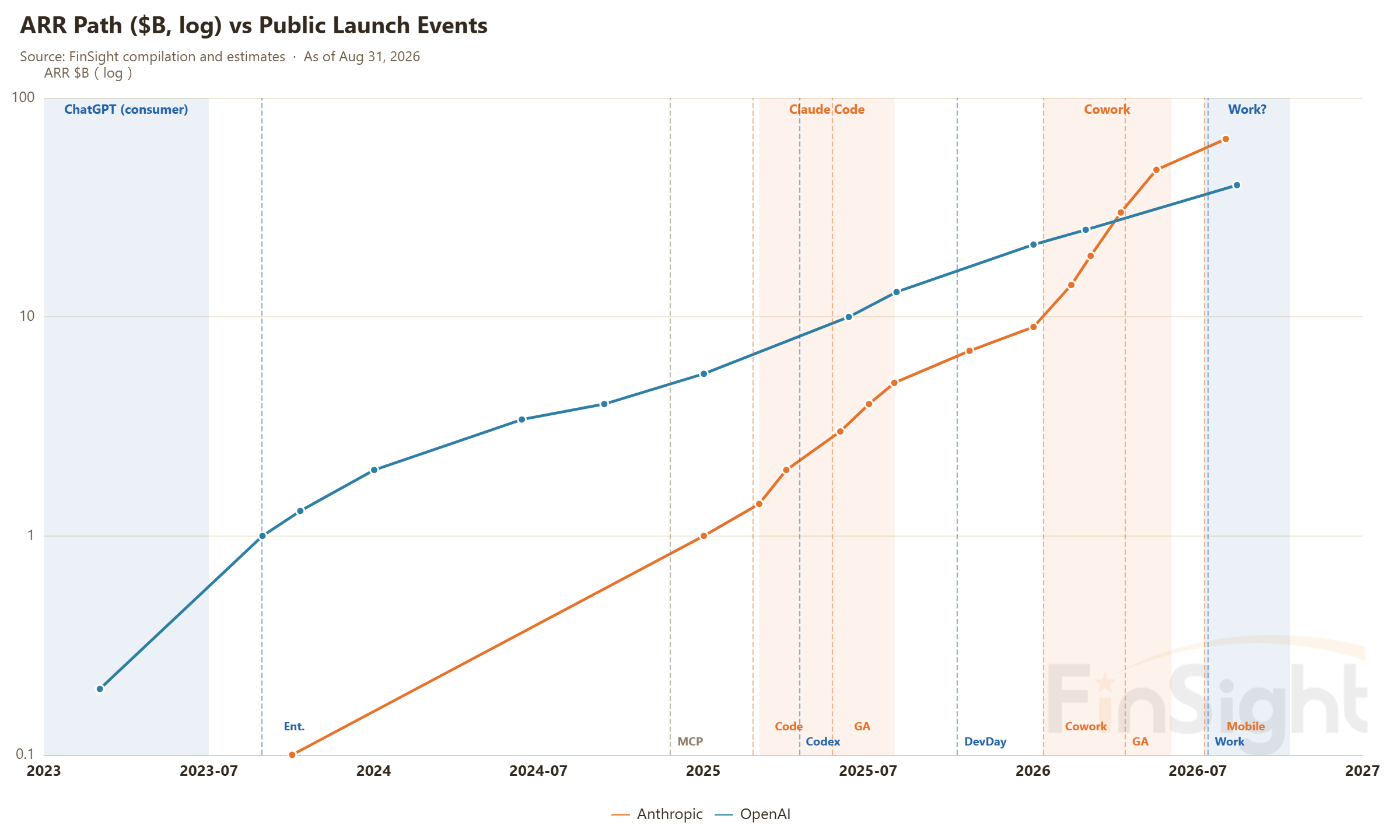
AI ARR reached $105.8B on August 13, running 23% ahead of the line we drew in July rather than missing it.
Both of the largest model companies updated their numbers in the past two weeks, and against optimistic expectations, both read a little light.
Key takeaways
- AI ARR is running two months ahead of our July line: $105.8B on August 13 against the $86B the path called for, 23% higher.
- The year-end $138B checkpoint needs only 5.9% a month from here, against the 14% to 20% the two leaders are still running.
- Data centers now have to absorb $13B of new annualized revenue every month, about $160B of new demand over a year.
- Each new chip is picking up $5,782 of new business, 2.4 times the $2,446 all-chip average. Nothing here changes the tight-compute call.
Start with what was reported. On OpenAI: press reports on August 14 put its annualized revenue run rate (ARR) above $40B, with the company saying July alone grew more than 20%, stronger than all of the second quarter. Then the Wall Street Journal filled in the actual second quarter on August 19: revenue of $6.7B, up 18% from the prior quarter, and the story said plainly that it came in below what some investors expected. On Anthropic: press reports on August 18 put ARR at $65B, and the Journal put second-quarter revenue at $11.6B, more than double the quarter before.
Every one of those is a record. The reaction was still muted, for a simple reason: the second quarter was extraordinary. Anthropic's ARR went from $9B at the start of the year to $47B in May, five times in five months, and plenty of people instinctively extended that line up and to the right. Draw it that way and $47B to $65B is only 40% more, so of course it feels like something slowed down.
Ramp's August piece, "Cracks in the AI thesis," pushes the same direction: fewer companies starting to pay, some switching to cheaper open-source models, and the most expensive model, Fable 5, at only 6% of usage. The conclusion was that what enterprises are willing to spend on AI has hit a ceiling.
That worry is fair. If new companies really stop arriving and existing customers stop adding spend, everything the vendors have committed to spend turns into overinvestment. That is the single biggest risk in the whole AI trade.
But "below expectations" raises a question: whose expectations?
No outside estimate is ever right. The only numbers that are right are the ones companies publish themselves. And most estimates get built by drawing a straight line, while AI growth has never been a straight line. So instead of checking these numbers against the market's estimates, we are marking our own July call to market.
Scorecard 1: in our model, slower growth was always part of the script
We wrote two posts in July. One said today's price hikes are the early innings and that AI compute gets scarcer at least through the second half of 2027. The other drew the cost line and concluded that at this slope, AI is about a year from paying for itself. What both were really doing was drawing one line: how fast AI revenue has to grow for compute to get tight enough to earn the money back. We drew it so we would have a scorecard to check against later. Later is now.
One assumption in that line matters more than the rest: the growth rate decays every year. We started at +300% year over year, already a haircut on the +440% actually recorded over the trailing 12 months and the +650% annualized over the trailing 6 months, and then assumed each year's growth comes in at 55% of the year before. We never believed AI revenue could keep compounding at second-quarter speed: big this year, a step slower next year, a step slower after that. Even with growth shrinking every year, the model still produced tighter compute, and a first shot at data center breakeven around the middle of next year.
So a slowdown is not a surprise to us. It is the script.
There are only two questions worth asking. Is the actual slowdown steeper than the line we drew, or gentler? And does it change the call that compute gets tighter for the next year and a half and hits the breakeven line by the middle of next year? The answer is that the numbers did not come in below our line. They came in above it.
| Baseline path (drawn in July) | Actual | Gap | |
|---|---|---|---|
| ARR, August 13 | about $86B | $105.8B (five companies combined) | +23% above the path |
| Year-end 2026 checkpoint | $138B | Needs +5.9% a month from here | The two leaders are running +14% to +20% a month |
Source: Company disclosures and press reports; FinSight compilation and estimates
On the line we drew in July, ARR does not reach $106B until the middle of October. It got there in the middle of August, roughly two months early. The year-end $138B checkpoint is the same story: from here it takes 5.9% a month, and the two companies' most recent months are running 14% to 20%. There is a lot of slack in that target.
Three things to hold in mind while looking at that chart.
- Part of the head start is old numbers catching up. Companies only speak when the number looks good: good news gets a press release, an ordinary stretch gets silence. So the rhythm of the disclosures tells you the state of the business. The ones talking constantly are the ones surging; the ones that go quiet are digesting. Anthropic put out a number almost every month through its big run. OpenAI's longest silence this year was five and a half months, and we now know that stretch covered its ugliest quarter, so this update dumps several months of growth in at once.
- The growth rate coming down was in our baseline from day one. We assumed decay from the start, so the thing to watch was never whether the growth rate falls. It was whether actual ARR keeps up with the line we drew.
- Honestly, the latest numbers are also below what we expected a month ago. If you use Fable 5 and GPT-5.6 Sol daily, the usage feels stronger than these revenue numbers imply. We would not rule out that both companies have been adjusting usage caps, the ceiling on how many tokens a user gets over a given period, and holding revenue down in the short run. But that is exactly the point of a scorecard: whatever you expected, you come back to the numbers and ask whether they change the assumptions.
Scorecard 2: is compute tighter than we thought?
The core metric in those earlier posts was annualized revenue per chip: add up the revenue of the five model companies and divide by the market's cumulative chip count, with every chip generation converted into H100-equivalents. When it rises, each chip has more business to carry and compute is tighter. It read $2,430 per chip in 2Q26, an 84% jump from $1,318 the quarter before, and the timing lines up exactly with GPU rental prices rising in December and AWS and Google Cloud both raising prices in January. When the metric spiked, the real world really was repricing. We dropped the two newly disclosed ARR figures in and reran it. Nothing changed: the shortage runs into the second half of next year, and the middle of next year is still the first real shot at covering the cost of a newly built data center.
Same chart as the July 22 post; the 2Q26 reading is $2,430.
One cross-check from the supply side. On its August 26 earnings call, NVIDIA's preliminary guide for the next fiscal year, which ends in January 2028, was roughly 70% revenue growth, and the company said outright that the number is capped by supply, that supply stays the bottleneck at least through the end of FY28, and that demand runs well above it. That is the same window we wrote about in July. This time it is the people selling the compute saying it.
We laid the thresholds out in a table: which cost line each level of AI ARR clears, and when. Drop in your own estimate and see whether the tight-compute call still holds.
| Compute at that date (M H100e) | Hold today's tightness ($2.45k) | New build, with depreciation: breakeven ($4.5k) | New build, with cost of capital: expansion sweet spot ($5.6k) | Marginal, with cost of capital ($6.5k) | Installed base, with depreciation ($7.5k) | Installed base, with WACC ($9.5k) | |
|---|---|---|---|---|---|---|---|
| End of 2026 | 43M | $104B | $191B | $238B | $277B | $319B | $404B |
| Mid-2027 | 52M | $126B | $234B | $291B | $338B | $390B | $494B |
| End of 2027 | 71M | $173B | $320B | $398B | $462B | $533B | $675B |
| End of 2028 | 114M | $277B | $514B | $640B | $743B | $857B | $1,085B |
Same table as in the July 22 post. Annualized revenue per H100e was $2,430 in 2Q26 against an all-chip average now running about $2,446.
Source: Epoch AI (CC BY 4.0); FinSight compilation and estimates
Here is a piece of logic people routinely skip. Whether compute is tight comes down to how much new business shows up each month against how many new chips come online each month. Both sides of that are actual quantities, not percentages.
Once the revenue base gets big, the growth rate falls by construction, but the dollars added each month can keep getting bigger. Anthropic is the cleanest example. It is adding $7.1B of annualized revenue a month right now. Five weeks of that is $9B, which is exactly what all of Anthropic was worth in ARR at the end of 2025. Put another way: even with monthly growth down from +20% in the spring to +14%, data centers now have to swallow an entire end-of-2025 Anthropic every five weeks, and chips arrive one at a time. They cannot be built that fast. That is why we put a decay factor in the model and still landed on tighter from here.
In dollars: $13B of net new ARR every month
Chart the new annualized revenue each of the two adds per month and you get what data centers actually have to absorb.
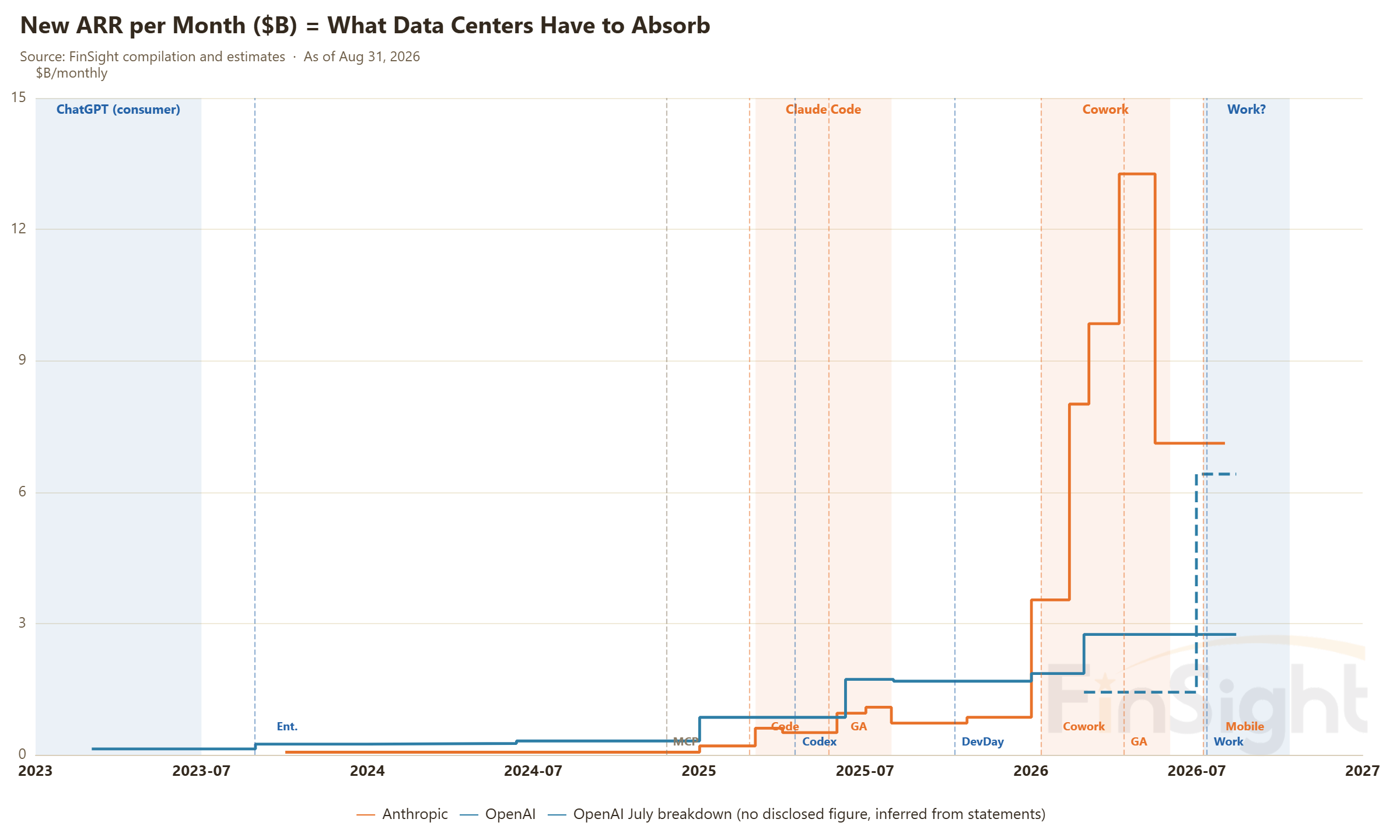
- Anthropic: $0.08B a month in 2024; $1B a month in the Claude Code era; $13.3B a month at the Cowork peak; and even now, in what people are calling a slowdown, still $7.1B a month.
- OpenAI: $0.2B to $0.4B a month early on, a steady $1.7B to $1.9B through 2025, then down to $1.4B in the spring of 2026, the only contraction in its history and exactly the stretch when Cowork was taking business from it, so that worry was well founded at the time. If the company's July number is right, it added $6.4B that month, the biggest in its history.
Together that is $13B of new annualized revenue a month, $160B of new demand over a year. Divide the new dollars each month by the new chips each month and you get new ARR per new chip. It is sharper than the overall average because it puts only incremental business against incremental chips. This chart answers one question: is newly installed compute picking up business faster or slower than before?
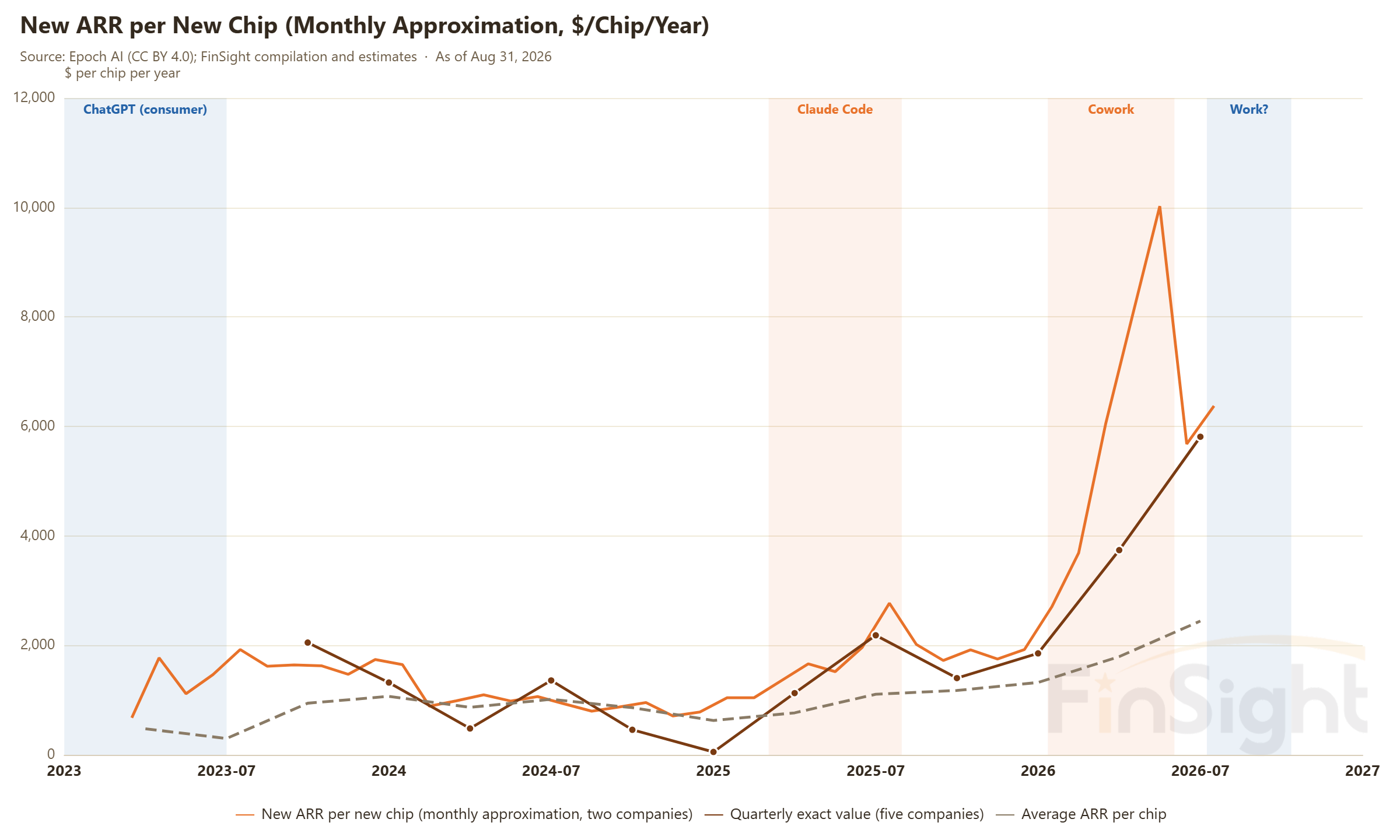
- At the end of 2024, a new chip picked up $52 of new business. The market added 1.90M chips that quarter and disclosed revenue barely moved. That is what a market running on faith alone looks like in the data, and the reason is that most of the compute was going into training the next generation of models. Training money does not come back until there is a product to sell.
- By the end of 2025 it was back to $1,850, and for two quarters running it sat above the average across every chip in the market, the metric from the last section. While everyone was worried about an Oracle blow-up, this is the line insiders were looking at.
- By the middle of 2026 it was $5,782, 2.4 times the all-chip average of $2,446, and that was done while 4.90M new chips landed in each of two consecutive quarters.
As long as each new chip picks up more business than the installed average, the shortage continues. The day new chips pick up less business than the installed average is the day to reassess.
One more thing shows up in that chart. Neither company's monthly additions form a smooth line. They step up, and every step lines up with a product launch. AI revenue has always been step-function growth, not a straight line, and anyone extrapolating a straight line ends up disappointed on the flat parts and surprised at the steps. That is the subject of our next post.
Scorecard 3: are new companies still arriving, and are existing customers still adding?
The first two lines of the scorecard were about revenue and compute, and neither one changed the tight-compute call.
But the ceiling Ramp is worried about sits one step upstream: are new companies still coming in, and are existing customers still adding spend? Those two decide what AI ARR looks like from here, so we split AI adoption into breadth and depth.
Breadth: out of every 100 US companies, how many pay for AI
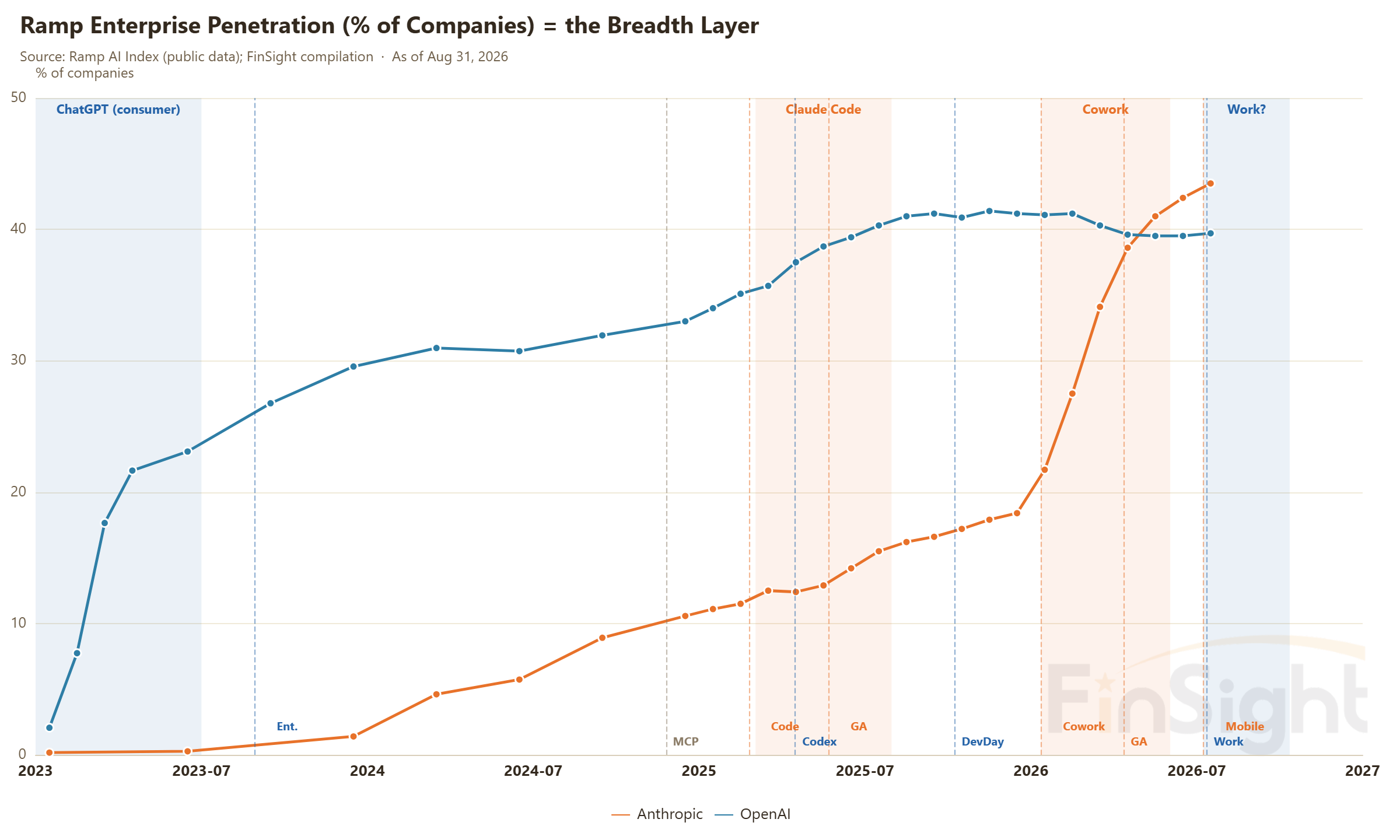
The chart is clear enough. The half-year after Cowork launched is where Anthropic's count of paying companies jumped hardest, passing OpenAI in May 2026. The Claude Code stretch was flatter on company count but still climbing the whole way. That earlier wave was mostly new companies arriving, not existing customers paying more.
July's month-over-month gain was only 1.1%, so yes, it slowed. But across three and a half years of data, neither company's count of paying companies has ever gone negative. The worst reading on record is still growth, just slow growth. Which industries these new companies sit in, and who is adding versus leaving, is a separate post.
Depth: how much the average employee spends on AI each month
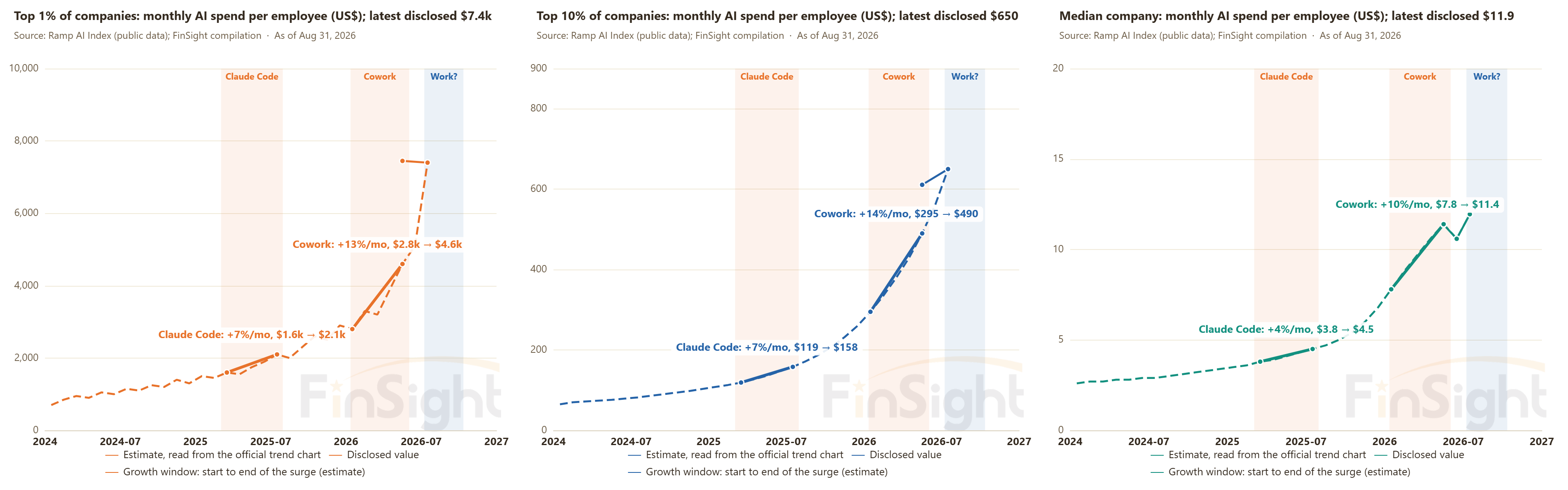
Two findings.
- During the Cowork launch stretch this year, it was not just the number of companies that jumped. Spend per company accelerated too, with growth at the top 1% and top 10% of companies running twice what it was in the Claude Code era. The worry that a flood of new customers would drag down average spend per company did not happen.
- July produced something unusual: only the top 1% surged, up 45% in a single month, while the top 10% and the median did not move. If a mass-market product like the Cowork phone app were driving this, the top 10% should have moved with it. Only the very top stepping up looks more like the least price-sensitive heavy users going deeper after Fable 5 shipped.
Ramp's own numbers line up with that: few people use Fable 5, 6% of usage, but they pay a lot, 11.4% of the dollars. Same data. Ramp reads it as a weak launch. We read it as Fable 5 opening a new product line, with top-end users willing to pay double for the strongest capability. September will tell us whose read was right.
As for whether competition this fierce between models means they simply take business from each other, that is a question about who captures the money, not about how much compute gets used in total. We took it apart in our last post on API pricing.
Bottom line: nothing here shakes the call that compute keeps getting tighter
The three things we checked:
- AI ARR is running two months ahead of the line we drew in July. That line said about $86B as of August 13; the five companies combined actually came in at $105.8B, 23% higher. The year-end $138B checkpoint needs only +5.9% a month from here, against current monthly growth of +14% to +20%. Growth did slow, but by less than we assumed.
- What data centers have to absorb is still getting bigger. The two companies together are adding about $13B of annualized revenue a month, $160B of new demand over a year, and each new chip is picking up $5,782 of new business, 2.4 times the all-chip average. On those numbers the timeline is unchanged: the shortage runs into the second half of next year, and the breakeven line comes into reach around the middle of next year.
- Breadth and depth of AI use are both still rising. The share of companies paying for AI keeps climbing, and the heaviest-spending top 1% raised spend 45% in July alone. Across three and a half years, neither company's monthly additions have ever gone negative. The worst reading on record is still growth, just slow growth.
The slowdown that worries the straight-line crowd is real. It was also written into our model from the start. To change our view, we do not need a lower growth rate. We need one of these two things.
- New ARR per new chip rolls over. It is at 2.4 times right now. The day it breaks below the all-chip average, currently $2,446 and rolling forward as more chips ship, newly installed compute has stopped picking up new business. That is an earlier warning light than any revenue announcement.
- The top end stops adding. July's depth growth was carried almost entirely by the top 1%. If top-1% spend falls back in September, and if what Cowork brought in was existing customers moving over rather than new companies joining, then Ramp's ceiling argument starts to make sense, and our confidence in that year-end $138B checkpoint has to come down with it.
We will keep tracking these numbers and update the moment the view has to change.
Next post: everyone watches AI ARR, but ARR is the last thing to move. Is there a way to see which direction it is heading one step earlier? We went back through the three earlier stretches of fast AI revenue growth, looked at where the momentum came from in each, and tried to find the tell.